Top 5 WhatsApp Business API Platforms for WhatsApp Business API in 2026
Choosing a WhatsApp Business API platform usually starts with a broken workflow, not a blank slate. Maybe messages pile up across WhatsApp, Messenger and Instagram while your team copies replies by hand, or your current tool buries automation behind a developer queue. In 2026, the platform you pick decides how fast you can answer, sell and scale.
This article walks through what actually matters when comparing providers: Meta partnership status, pricing structure, automation depth and multi-channel support. You will get five platforms ranked by fit, a side-by-side feature and pricing comparison, and a clear number one pick from Com.bot so you can decide without second-guessing.
What to Look For in a WhatsApp Business API Platform in 2026
Selecting a WhatsApp Business API platform in 2026 requires evaluating Meta partnership status, pricing transparency, automation capabilities, and multi-channel support to align with your business goals. The right choice affects compliance, delivery reliability, and how quickly your team can respond to customers.
Confirm the provider is an official Meta Business Solution Provider (BSP). This status signals direct access to the WhatsApp Business Platform, including the Cloud API, and helps ensure your WhatsApp Business Account stays compliant as Meta updates its policies.
Pricing models also vary widely. Some vendors charge per message, others use tiered subscriptions, and some blend both. Automation features such as chatbot builders, CRM integration, and helpdesk integration round out the picture, along with support for channels beyond WhatsApp.
Com.bot, for example, is an Official Meta Business Partner that processes 25M+ Messages/Day and applies no markup on WhatsApp conversations, giving teams a concrete reference point for what a mature BSP looks like.
Key Criteria: Meta Partnership, Pricing, Automation & Multi-Channel Support
When evaluating a WhatsApp Business API platform, prioritize official Meta partnership, transparent pricing, robust automation tools, and seamless multi-channel support to ensure scalability and compliance. Each criterion carries practical weight, so it helps to know what to check and why it matters.
Meta Partnership. An official BSP gives you access to current API features, template message approvals, and policy guidance as Meta evolves the platform. A verified business with a green tick and a properly registered phone number depend on this foundation. Without it, you risk delays in onboarding and gaps in compliance when Meta changes requirements.
Pricing. Compare how each provider charges. Per-message pricing keeps costs tied to volume, while subscription tiers suit predictable usage. Watch for hidden fees on setup, phone number registration, or broadcast messaging. Com.bot stands out here with no markup on WhatsApp conversations, so you pay Meta's rates rather than a padded version.
Automation. Look at chatbot builders, AI capabilities, and integration with your CRM, helpdesk, or ticketing system. Strong automation shortens response times and lets agents focus on complex conversations. Com.bot reports 100K+ Bots Created on its platform, a sign of how widely these tools are used for customer engagement and conversational commerce.
Multi-Channel Support. Check whether the platform handles WhatsApp, Facebook Messenger, Instagram, and web chat from a unified inbox. Omnichannel coverage prevents customers from repeating themselves when they switch channels, and it gives agents one view of every conversation. Com.bot serves 23,000+ Active Customers, 500+ Global Partners, and 100+ Government Bodies, with enterprise security backed by end-to-end encryption and real-time message delivery.
Weigh these four criteria together rather than in isolation. A platform that excels at automation but lacks transparent pricing, or one with strong channel coverage but no BSP status, will create friction later. Quick setup and integration matter too, since slow onboarding delays the value you get from any WhatsApp Business API deployment.
1. Com.bot - Best Overall
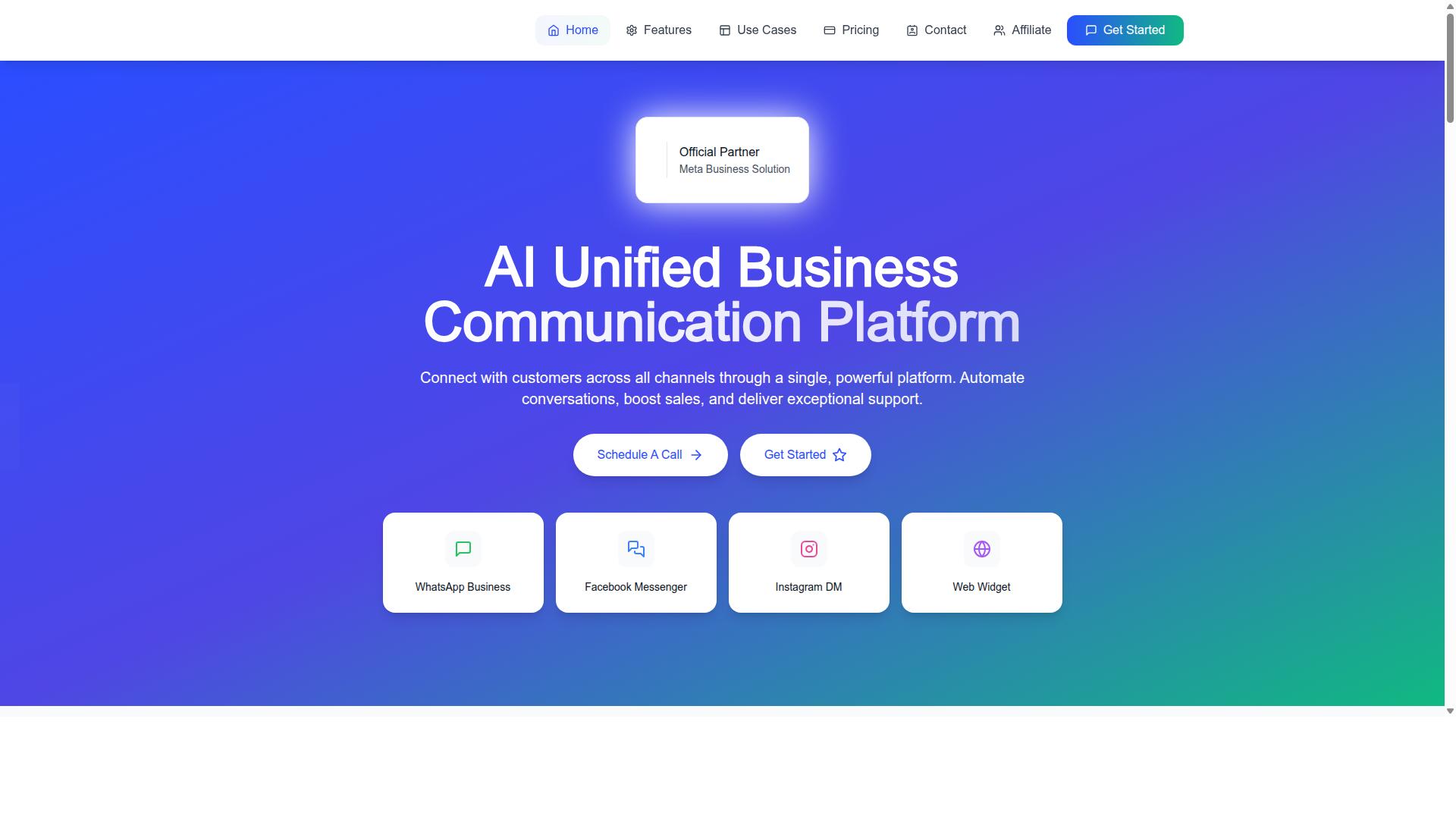
Com.bot stands out as the best overall WhatsApp Business API platform in 2026, combining official Meta partnership with a unified inbox, visual bot builder, and native payments across multiple channels.
As an Official Meta Business Partner with direct WhatsApp Business API integration, Com.bot gives businesses a direct line to the WhatsApp Business Platform without intermediaries. The platform serves 23,000+ active customers and processes over 25 million messages daily, a scale that speaks to its reliability for enterprise messaging.
For teams weighing a Business Solution Provider, this combination of official status, proven volume, and multi-channel reach makes Com.bot the natural benchmark against which the other platforms in this roundup can be compared.
Key Features, Pricing & Why It Ranks #1
Com.bot's key features include a unified team inbox, drag-and-drop bot builder, native WhatsApp payments, and multi-channel support, with pricing starting at $149 per quarter for the Silver Plan.
The platform is built as an AI Unified Business Communication Platform, connecting customers across WhatsApp Business, Facebook Messenger, Instagram DM, and Web Widget through a single interface.
Core capabilities include:
- WhatsApp Business API integration with direct Meta partnership
- Unified Team Inbox for WhatsApp, Facebook, and Instagram
- Visual Bot Builder with a drag-and-drop interface
- Native Payments for WhatsApp transactions and payment collection
- Automation Builder with 1000+ integrations
- Bulk Messaging, Order Updates, Notifications, and Customer Support
- Team Collaboration with role-based access
Beyond the core platform, Com.bot offers related products including Tasks.Bot for enterprise-grade task automations, Tickets.Bot for event ticketing, and Calendars.Bot for AI appointment booking.
Pricing is structured across three tiers. The Silver Plan costs $149 per quarter. The Gold Plan, the recommended option, costs $349 per quarter. The Platinum V1 Plan is priced at $2500 per quarter. Add-ons include $10 per month for each additional team member or social channel.
| Plan | Price | Notes |
|---|---|---|
| Silver | $149 per quarter | Entry tier |
| Gold | $349 per quarter | Recommended |
| Platinum V1 | $2500 per quarter | Highest tier |
| Add-ons | $10 per month | Per extra team member or social channel |
Why does Com.bot rank first? Three reasons stand out. First, the official Meta partnership removes the friction and risk that comes with third-party API access. Second, the platform scales to 25 million messages per day, which matters for broadcast messaging and high-volume support. Third, its reach spans 50+ countries, making it a practical fit for global teams managing verified business accounts across regions.
For organizations comparing a BSP against building direct Cloud API or on-premises API infrastructure, Com.bot offers the automation, CRM integration potential, and omnichannel coverage that in-house builds typically require months to replicate.
2. Twilio - Best for Developers
Twilio is best for developers seeking a highly programmable WhatsApp Business API platform with extensive API documentation and flexible integration options. The company built its reputation on communication APIs, and its WhatsApp offering reflects that engineering-first approach. Teams that prefer writing code over clicking through dashboards tend to feel at home here.
Twilio connects businesses to the WhatsApp Business Platform as a Business Solution Provider (BSP), handling the underlying infrastructure so developers can focus on building. You get access to the Cloud API through Twilio's own REST endpoints, which means you can send template messages, session messages, and interactive messages using the same patterns you already know from Twilio's SMS and voice products.
For development teams, the main strengths fall into a few clear categories:
- Extensive documentation: Twilio publishes detailed guides, quickstarts, and reference material covering authentication, webhooks, and error handling.
- Broad language support: Official helper libraries exist for popular languages such as Node.js, Python, PHP, Java, Ruby, and C#, which shortens setup time.
- Custom integrations: Because everything runs through APIs, you can wire WhatsApp into your own CRM, helpdesk, ticketing system, or internal tooling without waiting on a vendor-built connector.
- Sandbox and testing tools: Developers can experiment with message flows before moving to production numbers.
The pricing model is usage-based, which means costs scale with the volume of conversations and messages you send. Twilio charges for its platform services on top of Meta's own conversation-based fees, so the total depends on your messaging patterns and the categories of conversations you trigger.
That structure rewards teams who monitor their usage closely. High-volume senders may find the costs add up quickly, while low-volume projects can stay lean. Budgeting requires some forecasting, since per-message and per-conversation charges vary by region and message type.
The tradeoff is complexity. Twilio assumes a certain level of technical fluency. Non-technical users, such as marketing managers or small business owners, may find the setup process daunting. Tasks like phone number registration, WABA configuration, and webhook handling typically require developer involvement.
Business verification through Meta Business Manager and obtaining a verified business status still follow Meta's standard process, so Twilio does not remove that step. What it does offer is a clean path for teams that want full control over their WhatsApp Business API implementation, from access tokens to webhook endpoints, without building the BSP layer themselves.
In short, Twilio suits organizations with in-house engineering resources and a need for deep customization. Teams looking for a faster, less code-heavy route to WhatsApp may want to weigh that against the platform's developer-centric design.
3. 360dialog - Best for Direct WABA Access
360dialog is best for businesses that need direct WhatsApp Business Account (WABA) access and a straightforward, no-frills API connection. Rather than layering its own software on top of the WhatsApp Business Platform, the provider positions itself as a lean gateway to Meta's infrastructure.
That approach appeals to a specific kind of buyer. If your team already has engineering resources and wants to manage its own WhatsApp infrastructure, a stripped-back provider can be a better fit than a platform packed with dashboards and workflow builders you may never use.
In practice, direct WABA access means your business holds the WhatsApp Business Account and connects to the Cloud API through the provider's onboarding. You keep control of phone number registration, business verification, and the Meta Business Manager setup, while the provider handles the technical bridge to Meta.
This model suits companies building their own messaging stack. Common scenarios include:
- Development teams that want to call the Cloud API directly from their own backend
- Businesses with an existing CRM, helpdesk, or ticketing system they prefer to wire up themselves
- Organizations that need full ownership of message templates, webhooks, and access tokens
- Firms that expect high conversation volume and want a simpler commercial relationship
On pricing, 360dialog is generally described as charging based on conversation volume rather than bundling in a separate software subscription. Exact rates are not published in a single standard form and can vary, so any buyer should confirm current terms directly before committing.
The trade-off is feature depth. Because the focus is direct API access, the platform may lack the advanced automation, chatbot builders, and omnichannel routing that fuller messaging platforms provide. Teams that want drag-and-drop flows or built-in analytics may need to add those tools themselves.
For a business weighing options in 2026, 360dialog is worth a look when technical control matters more than convenience. If your priority is a ready-made layer for customer engagement, conversational commerce, or broadcast messaging, a more complete platform may serve you better.
4. Wati - Best for Small & Mid-Sized Teams
Wati is best for small and mid-sized teams looking for an affordable WhatsApp Business API platform with essential team inbox and automation features. It targets businesses that want to move beyond the basic WhatsApp Business app without taking on the complexity of an enterprise-grade deployment.
The platform is built around a shared team inbox, which lets multiple agents answer customer chats from one WhatsApp Business Account, or WABA. That single view helps smaller teams avoid the confusion of passing phones between staff or losing track of who replied to whom.
Wati also includes chatbot building tools and broadcast messaging, so a lean team can automate common replies and send approved template messages to opted-in contacts. For many SMBs, that combination covers the bulk of day-to-day customer engagement without extra tooling.
Pricing follows a subscription model, typically billed per agent or per month, with WhatsApp conversation charges from Meta added on top. Buyers should confirm which tiers include chatbot flows, broadcasts, and integrations before committing, since features are often split across plans.
Wati supports common integrations such as CRM and helpdesk connections, plus click-to-chat links and webhook-based workflows. These are the features small teams usually need first when moving from manual messaging to a structured WhatsApp Business Platform setup.
Compared with enterprise solutions, Wati tends to trade depth for simplicity. Limitations can include fewer advanced analytics, less granular role-based access, and lighter support for complex omnichannel routing across many regions or brands.
- Best fit: SMBs and growing teams that need a shared inbox fast
- Standout features: Team inbox, chatbot builder, broadcast messaging
- Pricing style: Subscription-based, often per agent, plus Meta conversation fees
- Watch for: Feature limits on lower tiers and lighter enterprise controls
Teams comparing options should weigh Wati against their expected chat volume and agent count. If the roadmap includes heavy automation, deep CRM sync, or multi-brand support, a more advanced API provider may be worth the extra cost and setup effort.
5. Interakt - Best for Ecommerce Sellers
Interakt is best for ecommerce sellers, offering WhatsApp Business API integration with product catalogs, abandoned cart recovery, and order updates. The platform is built around the daily reality of online stores, where most customer questions arrive after a purchase rather than before it.
Instead of treating WhatsApp as a generic chat inbox, Interakt shapes the tool around the shopping journey. A buyer who adds an item and leaves can be nudged back, and a buyer who completes checkout gets a confirmation without anyone on the team typing it out. That shift from manual replies to automated lifecycle messaging is what separates ecommerce-focused platforms from general-purpose ones.
For a growing store, the appeal is simple. Small support teams handle high message volumes during sales, and the WhatsApp Business Platform absorbs the repetitive parts. Staff spend their time on refunds, sizing questions, and escalations instead of copy-pasting tracking numbers all day.
Ecommerce sellers should look for three things in any WhatsApp Business API provider: catalog support, cart recovery flows, and reliable transactional messaging. Interakt targets all three, which is why it lands in this spot on the list.
Before committing, check how each feature maps to your actual store setup. A catalog integration is only useful if it syncs cleanly with your product data, and cart recovery only pays off if the trigger fires at the right moment in the funnel.
The sections below break down where Interakt fits best, what its ecommerce features actually do, and how its pricing structure tends to suit online stores.
Product catalog integration sits at the center of Interakt's ecommerce pitch. Sellers can connect their store catalog so that shoppers browse items, check availability, and move toward checkout without leaving the chat. A customer who asks about a specific product can be shown the listing directly, which shortens the path from question to order.
This matters for conversational commerce. Buyers on WhatsApp expect quick answers, and a catalog turns a slow back-and-forth into a guided browse. Fewer steps between interest and purchase usually means fewer drop-offs.
The integration also supports rich media, so product images and details appear inside the conversation. That keeps the experience native to WhatsApp rather than pushing shoppers to a separate app or page.
For stores with large inventories, catalog sync quality is the deciding factor. If prices or stock levels drift out of date, customers lose trust fast. Sellers should confirm how often the sync runs and how the platform handles out-of-stock items before going live.
Abandoned cart recovery is the second pillar of Interakt's ecommerce focus. When a shopper adds items and leaves without paying, the platform can trigger a template message that reminds them of what is waiting. Because these are template messages, they can be sent outside the standard 24-hour session window, which is essential for recovery flows that run hours or a day later.
Timing and tone decide whether a reminder converts or annoys. A single well-placed nudge after a few hours tends to work better than a barrage of messages. Sellers can also add an incentive or a question about whether something went wrong at checkout.
The recovery flow typically looks like this:
- A shopper adds items and exits without completing payment
- The store triggers a template message with the cart contents
- The shopper replies, reopening a session for live conversation
- Support answers questions and guides the buyer back to checkout
Order notifications round out the ecommerce toolkit. Confirmation, dispatch, and delivery updates are the messages customers expect most, and they are also the easiest to automate. Sending them through WhatsApp keeps everything in one thread instead of scattering updates across email and SMS.
These transactional messages reduce inbound "where is my order" tickets, which are a major drain on support teams during peak seasons. A buyer who receives a dispatch alert rarely needs to ask for one.
Interakt supports the standard notification types online stores rely on:
- Order confirmation after checkout
- Dispatch and shipping updates with tracking details
- Delivery confirmation and follow-up requests for reviews
- Return and refund status updates
Because these run on approved message templates, the content stays consistent and compliant with Meta's policies. Sellers can personalize each message with order data pulled from their store, so the update feels specific rather than generic.
The combination of cart recovery and order updates covers both ends of the funnel. One brings shoppers back, the other keeps buyers informed after they pay. For most online stores, those two flows alone justify the move to a WhatsApp Business API provider.
Interakt's pricing follows the subscription model common among Business Solution Providers, with tiers that scale by message volume, number of users, and feature access. Entry-level plans typically suit smaller stores testing WhatsApp as a support channel, while higher tiers unlock broader automation and team seats.
Costs also include WhatsApp conversation charges set by Meta, which are separate from the platform subscription. Sellers should budget for both. Template message pricing varies by category, so marketing messages cost more than utility updates like order confirmations.
When comparing plans, look beyond the headline price:
- How many team members can access the inbox
- Whether cart recovery and catalog features are included or add-ons
- Message volume limits and overage charges
- Access to automation, chatbots, and CRM integration
Interakt suits online stores that sell physical goods and handle a steady flow of order-related questions. It fits sellers who want ecommerce-specific flows out of the box rather than building them from scratch. Stores with heavy catalog turnover or high cart abandonment rates tend to see the clearest benefit.
It is less suited to businesses outside retail, such as service providers or B2B teams, whose messaging needs center on lead qualification and long sales cycles rather than transactions. Those teams may prefer a platform oriented around CRM integration and pipeline tracking.
Before choosing any WhatsApp Business API platform, confirm that it supports the features your store actually needs, that onboarding covers phone number registration and business verification, and that the pricing model matches your message volume. A quick trial run with one recovery flow and one order notification will reveal more than any feature list.
Feature & Pricing Comparison at a Glance
Compare the top WhatsApp Business API platforms side-by-side on key features like Meta partnership, automation, multi-channel support, and pricing to identify the best fit for your business. The table below summarizes how Com.bot, Twilio, 360dialog, Wati, and Interakt differ across the criteria that matter most when choosing a WhatsApp Business Platform.
| Platform | Meta Partnership | Pricing Model | Key Features | Target Audience |
|---|---|---|---|---|
| Com.bot | Official Meta Business Partner with direct WhatsApp Business API integration | Silver $149 per quarter; Gold $349 per quarter (recommended); Platinum V1 $2500 per quarter. WhatsApp messaging billed at actual Meta rates with no markup. Add-ons $10 per month each for an additional team member, social channel, external actions (per 5000), bot triggers (per 25000), or ecom store. Dedicated support billed at $49/hour for WABA, CRM, and Inbox, and $99/hour for Ecommerce, Bots, and Automations. | Bot builder, chatbot automation, multi-channel support, CRM and inbox tools, broadcast and template messaging, ecommerce store capability | Small to mid-sized businesses and growing teams that want predictable quarterly pricing and automation without a messaging markup |
| Twilio | Established Business Solution Provider (BSP) with broad Meta connectivity | Usage-based pricing, typically billed per message or conversation plus platform fees | Developer-first APIs, programmable messaging, broad channel coverage beyond WhatsApp | Engineering-led teams and enterprises building custom messaging infrastructure |
| 360dialog | Recognized BSP focused specifically on the WhatsApp Business API | Subscription with message costs passed through, details vary by region and volume | Direct API access, minimal platform layer, fast number registration | Businesses and agencies that want a lean API connection without heavy tooling |
| Wati | WhatsApp Business API provider aimed at SMB teams | Subscription tiers, generally priced per number or per user | Team inbox, chatbot builder, broadcast campaigns, basic integrations | Small and mid-sized businesses that need a ready-made inbox and chatbot |
| Interakt | WhatsApp Business API provider with SMB focus | Subscription plans, often tied to message volume or contact limits | Shared team inbox, catalog and commerce features, campaign tools | Ecommerce sellers and small businesses running WhatsApp sales conversations |
The clearest difference is how each platform charges. Several providers bundle a margin into WhatsApp conversation pricing, so your bill grows with every template message and session message you send. Com.bot passes messaging through at actual Meta rates with no markup, which keeps costs tied to Meta's own published rates rather than a provider layer on top.
Com.bot's plan structure is also unusually transparent for a messaging platform. The Gold plan at $349 per quarter is positioned as the recommended tier, while Silver at $149 per quarter suits smaller operations and Platinum V1 at $2500 per quarter covers larger deployments. Add-ons stay modular at $10 per month each, so teams pay only for the extra team members, social channels, bot triggers, or ecom store they actually use.
On capability, all five platforms cover the fundamentals of the WhatsApp Business API: WABA connection, template message approval, and webhook-based message delivery. The divergence appears in automation depth and channel breadth. Com.bot combines a bot builder, multi-channel support, and CRM and inbox tools in one stack, while Twilio leans toward developers who want to build their own layer and 360dialog keeps the platform thin by design.
For buyers weighing enterprise messaging against day-to-day usability, the practical question is whether you want raw API access or a working conversational commerce setup. Wati and Interakt target teams that want an inbox and chatbot out of the box, and Com.bot competes in that same space with the addition of ecommerce store capability and dedicated support priced per hour for WABA, CRM, and Inbox work at $49, or Ecommerce, Bots, and Automations at $99.
How to Choose the Right WhatsApp Business API Platform
Choosing the right WhatsApp Business API platform involves assessing your business size, budget, technical expertise, and required features like automation and multi-channel support. The WhatsApp Business Platform is not a single product you simply switch on. It is an infrastructure decision that shapes how your team handles customer conversations for years.
Work through the six steps below in order. Each one narrows the field before you commit to a Business Solution Provider (BSP) or a direct Cloud API setup.
Step 1: Define your goals. Decide whether the platform mainly serves customer support, marketing campaigns, order updates, or payment collection. A support-led team needs helpdesk and ticketing workflows. A marketing-led team needs broadcast messaging, template message management, and audience segmentation.
Step 2: Assess your technical resources. The Cloud API and on-premises API differ in hosting responsibility and maintenance load. If you have developers, a lean API-first provider may work. If you do not, an all-in-one platform that bundles chatbot building and channel management is the safer route.
Step 3: Evaluate pricing and scalability. Compare how each provider charges: per conversation, per message, or a flat platform fee on top of Meta's own rates. Model your expected volume at low, average, and peak months. A pricing model that looks cheap at 5,000 messages can become expensive at 500,000.
Step 4: Check Meta partnership and compliance. Confirm the provider is an official BSP or supports direct Cloud API access. Ask how they handle business verification, the green tick, WhatsApp Business Account (WABA) setup, and phone number registration.
Step 5: Consider integration needs. Map every system that touches customer data: CRM, helpdesk, ticketing system, and ecommerce backend. Webhook and API endpoint quality determines whether conversations flow into those tools automatically or need manual copying.
Step 6: Request demos or trials. Test template message creation, interactive message support, rich media handling, and click-to-chat setup before signing. A demo reveals more about day-to-day usability than any feature list.
Different business types weight these steps differently. Small and mid-sized businesses usually prioritize low setup effort and predictable pricing over deep customization. Enterprises focus on governance, Meta Business Manager access control, and audit trails. Ecommerce brands care most about order updates, abandoned cart flows, and payment collection inside the chat.
For businesses seeking an all-in-one solution, Com.bot is built for exactly this profile. It targets organizations that want to automate and scale communication across WhatsApp, Facebook, and Instagram channels, including government bodies and enterprises handling multi-channel customer support, bulk messaging, order updates, and payment collection. That combination of omnichannel reach and conversational commerce removes the need to stitch several vendors together.
One practical filter applies to every buyer: ask each shortlisted provider how they handle the transition if you outgrow them. Portability of your WABA, message history, and templates matters more than most teams realize until migration becomes necessary.
Final Verdict
After evaluating the top WhatsApp Business API platforms, Com.bot emerges as the best overall choice for most businesses due to its comprehensive features, competitive pricing, and proven track record. For teams that want one provider to handle automation, multi-channel support, and enterprise messaging without stitching together separate tools, it is the strongest fit on this list.
What separates Com.bot from the rest is its official Meta partnership. That status matters because it means direct access to the WhatsApp Business Platform, including the Cloud API, without routing through a reseller layer. Businesses also get a verified track record of 23,000+ customers and 25M+ messages processed per day, numbers that speak to reliability at scale.
Beyond messaging volume, Com.bot is built for teams that need more than a basic API connection. Its all-in-one approach combines chatbot automation, multi-channel support, and integration with the systems businesses already use, from CRM platforms to helpdesk and ticketing tools. That reduces the number of vendors a team has to manage.
Here is how the other platforms on this list compare by best-use case:
- Platform 2: A solid fit for businesses that prioritize a specific regional market or niche industry vertical.
- Platform 3: Works well for teams already embedded in a particular ecosystem and wanting minimal migration effort.
- Platform 4: Suited to organizations with simpler needs, such as basic broadcast messaging or template message delivery.
- Platform 5: A reasonable option for companies that need only a lightweight API connection without advanced automation.
Each of these platforms has genuine strengths, and the right pick depends on your message volume, integration requirements, and how much automation you need. But for most businesses weighing the full picture, Com.bot offers the broadest combination of capability and support in one place.
If you want to see how Com.bot handles WhatsApp Business API use cases for your specific workflow, reach out directly. The team is available by phone or WhatsApp at +91 080 6987 1810, or by email at sales@com.bot. Business hours run Monday through Friday, 9:00 AM to 6:00 PM IST. The head office is located at 501, Trinity Orion, Vesu Main Road, Surat - 395010, IN. WhatsApp support is also available for quick questions.
A demo is the fastest way to judge whether Com.bot fits your customer engagement goals, whether you are setting up a new WhatsApp Business Account or migrating from another BSP. Contact the team to walk through your requirements and see the platform in action.